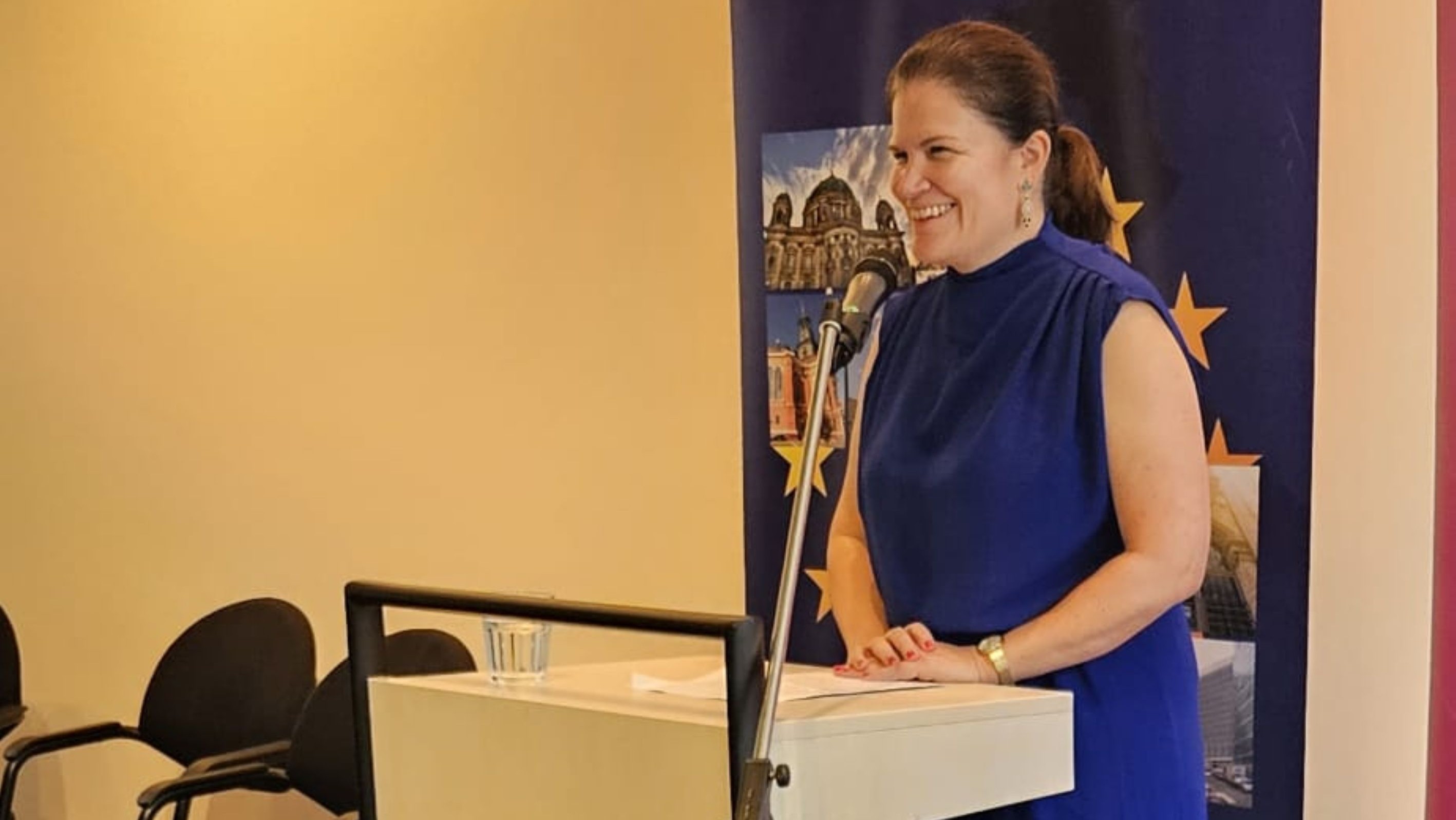
Grußwort von OKR'in Katrin Hatzinger zur Vorstellung des Friedensgutachtens 2026
Ladies and Gentlemen,
Distinguished speakers,
dear guests,
Welcome to this year´s joint event of the FES EU Office and EKD office Brussels highlighting once again an interesting chapter of this year´s peace report - the joint yearbook of the four leading German institutes for peace and conflict research. Thank you for your interest.
A warm welcome also to our distinguished speakers and panelists: Prof. Johannes Vüllers from the Institute for Development and Peace, MEP Udo Bullmann inter alia Member of the DEVE Committee and Floris Faber from ACT Alliance. Unfortunately, there was a misunderstanding about the participation of Ms Palmero-Vaquero and she finally cannot make it.
A big thank you goes to the FES for the great cooperation, especially to Sidonie, also for taking on the role as moderator and to my team.
In a time when the debate about the next EU multiannual budget is gaining momentum the topic of today could not be more timely: Sustainable peace or trade off? What future for European development cooperation?
No doubt, development cooperation is under pressure. Many countries underwent severe cuts in their budgets for development cooperation, especially the abolition of USAID is felt worldwide. More than ever, global solidarity and additional efforts are required. Yet instead, many wealthy countries - including Germany, the world’s third-largest economy - are reducing their public contributions to humanitarian aid and development cooperation.
Therefore, our Church Parliament, the EKD Synod underlined already at its last gathering in Dresden 2025 that “the commitment to humanity, human rights, and a life of dignity for every person is also an investment in lasting and just peace and thus a contribution to greater security. Because: The cuts of today are the crises of tomorrow.”
The Synod noted with great concern that the Federal Government, despite a growing federal budget, intends to make further drastic cuts in development cooperation. Humanitarian aid is expected to fall to its lowest level in a decade.
The Protestant Church in Germany has repeatedly underlined side by side with NGOs active in development cooperation that these cuts are counterproductive and come at the expense of the most vulnerable with a direct impact on the prospects for just peace worldwide.
Nevertheless, one has to take note of the geopolitical realities of today and it is clear that national as well as European budget proposals place a stronger emphasis on aligning development aid with direct strategic and security interests.
But to which extent is this transactionalism compatible with EU´s values and principles and the role of the EU and its Member States as the still biggest donor of development aid wordwide? Which alliances, which new strategical avenues are needed to ensure that development cooperation maintains its prominent role in EU´s political set-up and contributes to sustainable peace? I hope that our debate today will shed a bit of light on some of these questions.
One new avenue of international cooperation was opened at the United Nations General Assembly in New York last week: the EU, Australia, Barbados, Brazil, Canada, India and Kenya launched the “Partners for Multilateralism” initiative. In a joint declaration the signatories reaffirmed that the multilateral system based on the UN Charter remained indispensable and agreed to strengthen cooperation in support of peace, stability, inclusive and sustainable development, shared prosperity, human dignity and rights for all.
So, I am curious to learn about our panelists´ perspectives and wish us now all a fruitful debate.
With this I hand over to Philipp Goldberg, Deputy Head of the FES EU Office.